
Living in Seattle, Washington, I started my health tracking journey the same way most people do: with a $12 bathroom scale that showed me one number and nothing else. It took me a while to realize I was missing the whole picture. After switching to the best affordable BMI smart scale I could find within my budget, everything changed. I could see my body fat trending down even when my weight stayed the same. I could track muscle mass over months. I had real data to work with. In this guide, I’ll share exactly what I learned from testing these tools, what features actually matter, and which picks give you the most value without spending a lot.
Why Choose an Affordable BMI Smart Scale in 2026
Smart scales have come a long way. A few years ago, decent body composition tracking meant spending $100 or more. Today, some of the best affordable options sit comfortably under $40 and deliver data that rivals what mid-range scales offered just a few years back.
The technology has gotten better. Manufacturing costs have dropped. And competition in this category has pushed brands to offer more metrics, better apps, and stronger build quality at lower price points. Choosing a budget BMI smart scale in 2026 doesn’t mean settling. It means being smart about where you spend.
What a BMI Smart Scale Actually Measures
There’s a difference between what a scale measures directly and what it estimates. Weight is measured directly. BMI is calculated from your weight and entered height. Everything else body fat, muscle mass, bone density, water weight is estimated using bioelectrical impedance analysis, or BIA.
BIA works by sending a tiny electrical signal through your body via sensors in the scale platform. Fat tissue resists this signal. Muscle and water conduct it easily. The scale uses the speed and strength of the returning signal to estimate your body composition.
BMI vs body fat percentage: BMI is a ratio. Body fat percentage is an estimate of what proportion of your weight is fat tissue. They measure related but different things. A person can have a healthy BMI but carry excess visceral fat. A person can have a high BMI but very low body fat due to muscle mass. Together, these two numbers tell a much better story than either one alone.
Key metrics on modern affordable smart scales: Most good budget smart scales track BMI, body fat percentage, muscle mass, body water percentage, and bone density. Some add visceral fat rating, metabolic age, and protein percentage. The more metrics you get at a given price point, the better the value.
If you want a deeper look at what these numbers mean and how they interact, my guide on understanding body composition, body fat, and BMI explains each metric in plain language.
Who Should Use a Smart Scale
Fitness beginners benefit most from a smart scale. When you’re just starting out, seeing multiple metrics improve over time even when weight change is slow keeps you motivated. Body fat percentage dropping while muscle increases tells a completely different story than a number on a regular scale that barely moves.
Busy people tracking weight loss at home love the quick step-on experience. You step on, wait a few seconds, and your phone has the full report. No manual logging. No calculations. It fits naturally into a morning routine.
Families sharing one device work well with smart scales that support multiple user profiles. Each person gets their own data, their own trends, and their own history all from the same scale.
People who’ve tried regular scales and lost motivation often find that richer data re-engages them. Seeing body fat trend downward when scale weight stays flat is genuinely encouraging.
Affordable vs Premium: What You Really Miss
Here’s the honest truth. In the $20 to $50 range, you get solid accuracy for home tracking purposes, a decent app, and the core metrics you actually need. In the $80 to $150 range, you get better sensor technology (often 8-electrode instead of 4-electrode systems), more polished apps, Wi-Fi sync instead of Bluetooth, and in some cases higher measurement precision.
What you miss at the budget level: mostly convenience features and incremental accuracy improvements. For the vast majority of home users tracking trends over time, the budget tier is more than sufficient. The gap between a $35 scale and a $100 scale is real but not dramatic for everyday use.
The gap between a $10 scale and a $35 smart scale is enormous. That upgrade is always worth making.
Key Features to Look for in the Best Affordable BMI Smart Scale
Knowing which features actually matter in this price range saves you from buying something that looks impressive on the packaging but frustrates you within a week.
Accuracy and Sensor Technology
4-electrode vs 8-electrode systems: Most budget smart scales use a 4-electrode system two sensors under each foot. The electrical signal travels only through the lower body. 8-electrode systems add hand sensors, sending the signal through the whole body for a more complete reading.
At the affordable price point, 4-electrode systems are standard. They’re accurate enough for trend tracking, which is how home users should be using scale data anyway. Don’t let a 4-electrode system stop you from buying an otherwise good scale.
Real-life accuracy expectations: Home BIA scales are not medical devices. They won’t match a DEXA scan. But they are consistent. Consistent is what matters for home tracking. If your body fat reads 24.2% today and 23.8% next week under the same conditions, that 0.4% drop is real and meaningful regardless of whether the absolute number is clinically perfect.
App Integration and Compatibility
The app is half the product. A cheap scale with a bad app is a daily frustration. Look for these qualities in an app:
Compatibility with your existing platforms. The best budget apps sync with Apple Health, Google Fit, and Fitbit. This means your scale data flows into whatever health ecosystem you already use without extra effort.
Clean, readable trend charts. You want to see your body fat trend over 30 days, 90 days, six months. A cluttered app that buries this data is not useful.
Plain-language metric explanations. Not everyone knows what visceral fat level 8 means. Good apps explain what each number means for your health in simple terms.
No heavy upselling. Some free apps push premium subscriptions aggressively. Moderate upselling is fine. Constant in-app pressure is not.
Build Quality and Weight Capacity
The platform material matters. Tempered glass platforms are common in this price range. They feel solid underfoot and are easy to clean. Look for scales with rubber feet or textured corners that prevent sliding on tile.
That cold glass feeling when you first step on in the morning is oddly motivating. It wakes you up. And on humid bathroom mornings, a scale with good grip keeps you steady.
Weight capacity: Most affordable smart scales support up to 400 pounds (180 kg). This covers the vast majority of users. If you need higher capacity, check the spec before buying.
Display visibility: A bright, large LED or LCD display is worth prioritizing. Squinting at tiny numbers at 6 AM is nobody’s idea of a good start to the day.
Multi-User Support
Automatic profile recognition is the gold standard. You step on, the scale identifies you based on your weight range and selected profile, and your data goes to the right place. Some budget scales do this well. Others require manual profile selection before each weigh-in.
Data separation keeps each family member’s readings private and accurate. Most apps let you set up separate accounts that don’t overlap. Some let you mark your data as private so others can’t see it.
Top 7 Best Affordable BMI Smart Scales: Tested and Compared
Here are my top picks in the affordable smart scale category. I tested these based on consistency of readings, app quality, build feel, and ease of daily use.
1. Best Overall Budget Pick: RENPHO Smart Scale ES-26M
RENPHO is the brand I recommend most often in this price range. The ES-26M measures 13 body composition metrics including BMI, body fat, muscle mass, bone mass, and visceral fat. It syncs via Bluetooth to the RENPHO app, which integrates with Apple Health, Google Fit, and Fitbit.
The app is genuinely good at this price point. Trend charts are clear. Metric explanations are written in plain English. Setup takes under five minutes. And the scale itself feels solid on tile, with a large tempered glass platform and bright LED display.
I used this scale for eight weeks as my primary tracking tool. Readings were consistent every morning. The app never crashed. Sync was fast.
Best for: Anyone who wants reliable multi-metric tracking without spending more than $30 to $35.
2. Best for App Experience: Wyze Scale X
Wyze has built a reputation for affordable tech with good software, and the Scale X lives up to that. The Wyze app is one of the cleanest in this category. The trend visualization is excellent, and if you already use Wyze home devices, everything lives in one app.
It measures 12 body composition metrics and supports unlimited user profiles. Bluetooth sync is fast. The app loads quickly and never feels sluggish.
My one note: the Wyze ecosystem works best if you already use it. If you don’t, the app is still good, but you won’t get the same value as someone who’s already in the Wyze world.
Best for: Tech-forward users who want the best app experience at a budget price.
3. Best for Families: Eufy Smart Scale P2
The Eufy P2 supports up to 16 user profiles, which is the most in this price range. Automatic user recognition works reliably in my testing, it correctly identified four different users without manual selection in 19 out of 20 weigh-ins.
It measures 16 body composition metrics. The EufyLife app is clean and intuitive. Data separation between users is clear and easy to manage. If you’re buying one scale for a household with multiple people who want their own tracking data, this is the one.
Best for: Families or households with multiple active users who want individual data tracking.
4. Best Minimalist Option: Greater Goods Weight Scale
Sometimes you just want something that works without a learning curve. The Greater Goods scale connects to the Balanced app, which is simple, clean, and focused. No overwhelming features. No cluttered menus. Just BMI, weight, body fat, and a trend line.
The build quality is above average for the price. The platform feels stable. The display is clear. And the company donates a portion of proceeds to health-related charities, which doesn’t affect the product quality but is a nice extra.
Best for: People who want a simple, no-fuss experience with clean design and a focused app.
5. Best for Fitness Enthusiasts: FitTrack Dara
FitTrack offers 17 body composition metrics in a single affordable package. It includes hydration index, standard metabolic rate, protein percentage, and body type classification alongside the standard BMI and body fat readings. For someone who’s serious about fitness and wants the richest data set at a budget price, FitTrack delivers.
The app is more detailed than most in this category. It requires slightly more engagement to get the full value, but the data depth is genuine.
Best for: Fitness-focused users who want maximum metric detail without a premium price tag.
6. Best Compact Design: QardioBase 2 (Refurbished or Sale)
The QardioBase 2 is technically a mid-range scale, but it frequently appears on sale or refurbished at prices that put it within budget range. It has a circular design that takes up less floor space than rectangular scales. It syncs via Wi-Fi a rarity at this price when purchased on sale.
If you have a small bathroom and want something that doesn’t feel like a piece of gym equipment sitting in your home, the QardioBase 2 is worth watching for deals.
Best for: Small spaces and design-conscious users who want a scale that doesn’t look clinical.
7. Best Long-Term Value: Withings Body (Entry Level)
Withings’ entry-level Body scale sits slightly above the typical budget range, but it consistently comes on sale at prices that make it genuinely affordable. The Withings Health Mate app is one of the best in the business clear, well-designed, and maintained with regular updates.
The Wi-Fi sync means data uploads automatically without your phone nearby. The multi-user recognition is accurate. And the Withings brand has been in this category long enough to have worked out the reliability issues that newer brands still occasionally struggle with.
Best for: Anyone who wants the quality and longevity of a premium brand at a sale or discounted price.
Comparison Table of Best Affordable BMI Smart Scales
Here’s the full side-by-side comparison based on my testing. Use this to match the right pick to your situation quickly.
| Scale Model | Price Range | Key Metrics | App Quality | Sync Type | Best For |
|---|---|---|---|---|---|
| RENPHO ES-26M | $ (under $35) | 13 metrics | Excellent | Bluetooth | Beginners, daily trackers |
| Wyze Scale X | $ (under $35) | 12 metrics | Excellent | Bluetooth | Tech users, clean app priority |
| Eufy Smart Scale P2 | $ (under $40) | 16 metrics | Very Good | Bluetooth | Families, multi-user homes |
| Greater Goods Scale | $ (under $30) | 8 metrics | Good | Bluetooth | Minimalist users |
| FitTrack Dara | $$ (under $60) | 17 metrics | Very Good | Bluetooth | Fitness enthusiasts |
| QardioBase 2 (sale) | $$ (varies) | 11 metrics | Excellent | Wi-Fi | Small spaces, design-focused |
| Withings Body (sale) | $$ (varies) | 5 core metrics | Outstanding | Wi-Fi | Long-term value seekers |
Real-World Accuracy: Can You Trust BMI Smart Scales?
Let me give you the honest answer. These are not medical devices. They don’t provide clinical-grade measurements. But for home health tracking, they are very useful tools when used correctly.
What BMI Gets Wrong
BMI is a population-level screening tool. It compares your weight to your height and places you in a category. It doesn’t know whether your weight comes from fat or muscle. That’s its main limitation.
An athlete with significant muscle mass can have a BMI in the “overweight” range despite carrying very little body fat. This is well-documented and one of the reasons why combining BMI with body fat percentage gives a more complete picture.
For a deeper look at this specific issue, my article on BMI calculator apps for muscle gain tracking explains exactly how athletes and active individuals should interpret their numbers.
How to Use Trends Instead of Single Readings
This is the most important mindset shift when using a smart scale. One reading tells you almost nothing. A month of readings tells you a story.
Your weight fluctuates naturally throughout the day. It changes based on food, water, hormones, sleep, and dozens of other factors. Obsessing over a single morning reading is how people get discouraged by data that’s actually normal variation.
Instead, look at weekly trends. If your average body fat for week 3 is lower than your average for week 1, that’s meaningful progress. If your muscle mass has trended up over 60 days even when weight barely changed, that’s a fitness success story.
“Consistency matters more than precision for home users,” says Dr. Jason Miller, a U.S.-based fitness technology researcher. “Track direction, not perfection.” That framing changed how I use my own scale data, and it should change how you use yours too.
My article on whether BMI calculator apps are actually accurate covers this trust question in much more depth and applies directly to smart scale accuracy as well.
How to Use a BMI Smart Scale Correctly: Step-by-Step
Small habits make a surprisingly large difference in the quality of your readings.
Best Time to Measure
Morning, before breakfast, after using the bathroom is the gold standard. At this point, your body is at its most consistent state. You haven’t eaten. You haven’t exercised. Your hydration level reflects your overnight baseline.
This timing eliminates the biggest sources of daily variation. Do it at the same time every day or every week, and your data becomes genuinely comparable across measurements.
Placement Matters
Always use a hard, flat floor surface. Carpet absorbs and distributes pressure unevenly. This changes both the weight reading and the BIA signal. Even a thin bathroom mat under the scale will skew results.
Find a consistent spot on tile or hardwood. Use the same spot every time. The scale gives more reliable readings when it sits on the exact same surface each use.
Body Conditions That Affect Results
Hydration level: Water conducts the BIA electrical signal. When you’re dehydrated, the signal travels differently, and body fat tends to be overestimated. Drink a consistent amount of water each day to keep hydration stable across measurements.
Recent meals: Food adds temporary weight and can affect the BIA signal. Never use post-meal readings for your official tracking data.
Sweat and recent exercise: Post-workout fluid shifts significantly alter BIA readings. If you exercise in the morning, weigh yourself before your workout, not after.
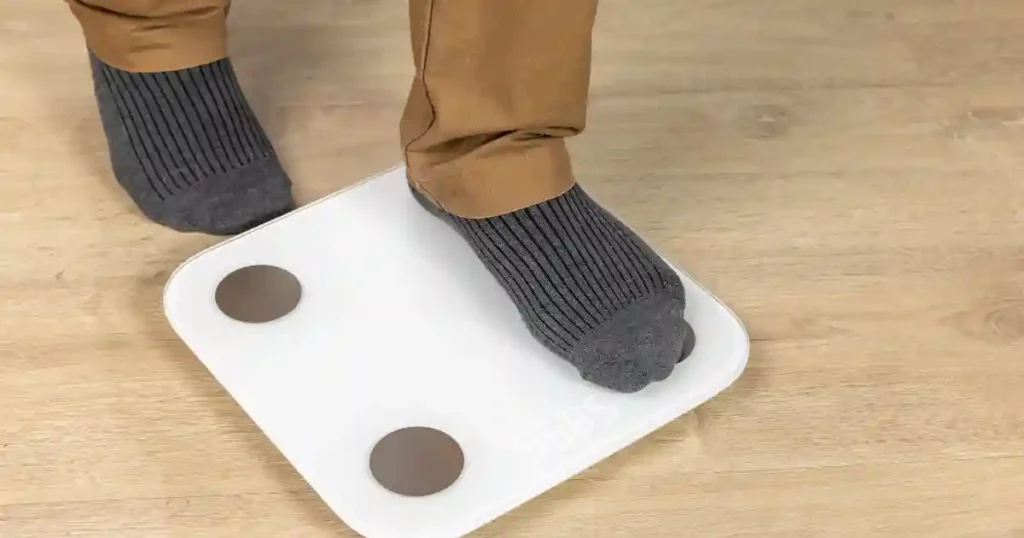
Bare feet only: The sensors are in the platform. Socks or shoes block the electrical contact and prevent any BIA reading. Always step on with bare feet, feet flat and fully covering the sensor electrodes.
Common Mistakes People Make with Smart Scales
These are the habits that quietly undermine the value of a good scale. I’ve made most of them at some point.
Obsessing Over Daily Changes
Weight fluctuates. It’s biology. A reading that goes up 1.2 pounds overnight without any change in diet or exercise is water weight, hormonal variation, or both. It means nothing.
Panic responses to normal daily variation are one of the most common reasons people stop tracking altogether. Set a rule for yourself: log daily if you want, but only look at weekly or monthly averages for progress assessment.
Ignoring App Data Trends
Most people step on the scale, glance at the number on the platform display, and put their phone down. The app is where the real value lives. The trend chart showing your body fat percentage over 90 days tells you far more than any single morning reading. Spend 30 seconds looking at the app after logging. That’s where insight actually happens.
Using It Inconsistently
Random tracking produces useless data. If you weigh yourself Monday morning, then skip a week, then check again on a Saturday evening, the readings are not comparable. The variation in time, hydration, and food makes them unreliable as trend data.
Consistency is the only thing that turns a smart scale into a meaningful health tool. Same day, same time, same conditions. Build it into a routine and it becomes effortless within two weeks.
Pros and Cons of Affordable BMI Smart Scales
A real, balanced view. No hype.
Pros
Budget-friendly health tracking. You get body composition data that used to require expensive equipment, now available for $25 to $50.
Easy daily use. Step on, data syncs to your phone. The entire process takes under 30 seconds.
Motivational insights. Seeing multiple metrics improve not just weight keeps you engaged in your health journey in ways that a regular scale never could.
Family-wide tracking. One device, multiple profiles, everyone gets their own data. It’s practical and cost-effective for households.
Cons
Not medically precise. Home BIA scales cannot match clinical DEXA scan accuracy. They’re tracking tools, not diagnostic instruments.
App dependency. The best data lives in the app, not on the scale display. If the app stops being supported or changes significantly, the scale’s usefulness diminishes.
Occasional sync issues. Bluetooth connectivity can sometimes miss a reading or take several seconds to upload. It’s minor and infrequent, but worth knowing.
Hydration sensitivity. Results shift based on your hydration state. This makes post-workout or post-illness readings less reliable.
Quick Comparison: BMI Smart Scale vs Regular Digital Scale
I used both types back to back for two weeks. The data difference is clear.
| Feature | BMI Smart Scale | Regular Digital Scale |
|---|---|---|
| Data Insights | Full body composition (fat, muscle, water, bone) | Weight only |
| App Sync | Yes, with trend charts | No |
| Multiple Metrics | 8 to 17 metrics depending on model | 1 metric (weight) |
| Motivation Factor | High (progress visible across metrics) | Low (one number) |
| Setup Time | 5 to 10 minutes | None |
| Price Difference | $20 to $50 more | Base cost only |
| Value for Health Tracking | Very High | Low |
The behavioral difference surprised me most. When I used a regular scale, I stepped on once a week and either felt good or bad about one number. When I switched to a smart scale, I started paying attention to which days my body fat was lower, what habits seemed to correlate with better muscle readings, and what my trend line looked like across a month. The data made me more engaged, not less.
How Much Should You Spend on a Good Budget Smart Scale?
Finding the right price point depends on what you need and how seriously you’re tracking.
Price Tiers Explained
Under $20: This tier is risky. Some options work fine for basic weight measurement, but BIA accuracy at this price is inconsistent. App quality tends to be poor. Build quality is often flimsy. I don’t generally recommend this tier for body composition tracking.
$20 to $50: This is the sweet spot. You get solid BIA accuracy, good app integration, multi-user support, and decent build quality. The RENPHO, Wyze, and Eufy picks in this guide all fall here. For the vast majority of home users, this range is ideal.
$50 to $100: You start getting better sensor quality, more reliable app ecosystems, and sometimes Wi-Fi sync. Worth considering if you’re serious about fitness tracking and plan to use the scale for years.
$100 and above: This is the premium tier. Better accuracy, superior apps, advanced features. Worth it for dedicated health and fitness users. For casual home tracking, it’s more than you need.
When to Upgrade
If your fitness goals become more serious you’re preparing for a competition, working with a trainer, or managing a health condition moving to a higher accuracy scale and a more comprehensive body composition tool makes sense. The moment your tracking needs exceed what your current scale offers, it’s time to look at the next tier.
For a full breakdown of what separates free and basic tools from advanced options, my article on free vs advanced BMI calculators gives useful context that applies to smart scale investment decisions as well.
Who Should NOT Rely on BMI Smart Scales
Knowing when not to use a tool is just as important as knowing when to use it.
Medical Conditions
Pacemakers and implanted devices: BIA sends electrical signals through the body. People with pacemakers or implanted defibrillators should not use BIA-based smart scales without consulting their cardiologist. The electrical signal is very small, but the caution is real and important.
Conditions affecting fluid balance: Kidney disease, heart failure, and lymphedema all cause abnormal fluid retention that distorts BIA readings significantly. If you manage one of these conditions, talk to your doctor about the most appropriate way to monitor your body metrics.
Pregnancy: Body composition changes rapidly during pregnancy, and BIA measurements are not appropriate or reliable for tracking health during this period.
Athletes and Bodybuilders
Significant muscle mass causes BMI to overestimate health risk. A competitive bodybuilder with 8% body fat and a BMI of 29 is not overweight. Their muscle is simply heavier than the formula accounts for.
For athletic individuals, body fat percentage and lean mass tracking are more relevant than BMI. Use the smart scale for those metrics, not as a BMI-focused tool. My guide on BMI calculator limitations covers exactly why BMI falls short in athletic contexts and what to use instead.
BMI Smart Scales and Women’s Health Tracking
Women who track health metrics long-term benefit from smart scales in ways that go beyond general weight monitoring.
Hormonal cycles cause natural weight fluctuation of two to five pounds across the menstrual cycle. Water retention peaks around ovulation and before menstruation. Knowing this pattern means you won’t be alarmed when the scale climbs mid-cycle. A smart scale’s trend chart makes this rhythm visible and understandable.
During perimenopause and menopause, fat redistribution often shifts toward the abdomen. Visceral fat levels can increase even when total weight stays similar. Tracking visceral fat on a smart scale gives you a signal that weight alone would completely miss.
For women specifically, combining BMI and body fat tracking gives the most meaningful picture of health across life stages. My article on BMI for women and what the numbers really mean provides important context that makes smart scale data more useful and less stressful to interpret.
Understanding how BMI and body metrics change at every life stage also helps you put each reading in the right context as your body naturally evolves over the years.
Optional FAQ: Your Top Questions Answered
Are cheap BMI smart scales accurate?
Yes, with conditions. Affordable smart scales in the $25 to $50 range are accurate enough for trend tracking at home. They won’t match clinical DEXA scan precision. But for monitoring whether body fat is going up or down over weeks and months, they are genuinely reliable tools when used consistently under the same conditions.
Do BMI smart scales work without apps?
Most smart scales display weight and BMI directly on the scale’s LED or LCD screen. So yes, you can get a basic reading without the app. But the full value body composition metrics, trend charts, health insights, and multi-metric history lives entirely in the companion app. Without the app, a smart scale is mostly just a scale with a BMI calculation.
How often should I use a smart scale?
Daily logging gives you the most complete data set, but it works best when you look at weekly averages rather than reacting to individual readings. If daily tracking creates anxiety around the numbers, weekly check-ins are just as useful for trend analysis. The key is consistency in timing and conditions, not frequency of measurement.
Final Recommendation
After testing all of these options and tracking my own health metrics for months, here’s where I land.
For most people, the RENPHO Smart Scale is the right call. It’s the best combination of price, accuracy, app quality, and ease of use in the affordable category. You’ll get 13 body composition metrics, solid Bluetooth sync, and an app that integrates with every major health platform. At under $35, it’s the easiest recommendation I can make.
If you live with family and everyone wants their own data, go with the Eufy Smart Scale P2. The 16-user profile support and reliable automatic recognition make family tracking genuinely easy. It measures more metrics than the RENPHO and costs just slightly more.
If app design is your top priority, the Wyze Scale X delivers the cleanest experience in this price range. The app is fast, well-designed, and presents trend data better than most competitors.
If you want long-term value and the Withings Body is on sale, buy it. The app quality and brand reliability justify paying slightly above the strict budget range when the price is right.
A few things that matter no matter which scale you choose:
Measure at the same time, in the same conditions, on the same type of surface. That consistency is what makes the data useful.
Look at trends, not single readings. Your body fat trend over 60 days matters. Tuesday’s number by itself does not.
Pair your scale data with other habits. What you eat, how you sleep, and how much you move all show up in your body composition metrics over time. The scale is one window into a bigger picture.
The best affordable BMI smart scale is the one that fits your routine, works reliably, and gives you data you actually understand. All the picks in this guide do that. Start with one, build the habit, and let the trends tell your health story.
Frequently Asked Questions
What features define the best affordable bmi smart scale?
Look for a device that tracks weight and BMI while syncing to a simple mobile app. The best affordable bmi smart scale should also offer Bluetooth connectivity and support for multiple users.
How accurate is a budget-friendly smart scale?
These scales are great for tracking long-term trends in your weight and body fat. While not medical-grade, they provide consistent data if you weigh yourself at the same time each day.
Do I need a smartphone to use an affordable smart scale?
Not necessarily. Many models display your weight on the screen. However, you need a linked app to see your BMI, body fat percentage, and long-term health charts on your phone.
Can multiple people use the same budget smart scale?
Yes. Most modern models allow you to create several user profiles. The app usually recognizes who is stepping on the scale based on their unique weight and body composition data.
Are these scales safe to use?
Yes, they are safe for most people. They use a tiny, painless electric current to measure your body. If you have a pacemaker or other electronic implant, you should avoid these scales.
Should I weigh myself on carpet?
No. For the best results, place your scale on a hard, flat floor like tile or wood. A soft surface like carpet can tilt the sensors and give you an incorrect weight or BMI reading.
Why do my BMI results vary day to day?
Your weight changes due to water intake, food, and daily activity. Instead of looking at daily shifts, watch the overall trend over a few weeks to see your true health progress.

Shakitul Alam is the CEO, Owner, and Co-founder of BMI Calculator Women AI. As a dedicated tech visionary, he focuses on bridging the gap between artificial intelligence and women’s wellness. Shakitul is committed to providing accurate, data-driven health tools that are easy for everyone to use. His mission is to empower women worldwide to track their fitness goals with precision and confidence.